Cell tower lease buyout: get a stronger offer
The short answer
Don't judge a buyout by the check alone. Use 15 to 22 times your yearly rent as a starting range to compare offers. Then push for better terms where your lease allows.
What could change the answerRent increases, time left on the lease, future income from new tenants, competing bids and the rights the buyer wants.
A buyout trades your future rent for one lump sum now. To get a good deal, know what you will actually get, what rights you are selling and what stays your job.
Before you sign
Check the money, the rights you sell and your next step.

What is the offer multiple?
The multiple tells you how many years of rent the offer equals. It is the quickest way to size up an offer.
Buyout offer ÷ current yearly rent = offer multiple.
Use your base rent, times 12. Leave out one-time payments and money that only pays you back for costs. The multiple does not show rent increases, renewal options, the tower company's right to cancel, future income or the rights you give up.
Use 15 to 22 times yearly rent as a starting range. If your lease is strong, aim for the high end. Don't treat the first offer as the best you can get.
Say you get $2,000 a month. That is $24,000 a year. A 15x offer would be $360,000. A 22x offer would be $528,000. That is a $168,000 difference on the same rent.
What earns a higher offer? Strong rent increases, steady income, rights to future income and more than one bidder. If the buyer wants a long easement or broad rights over your land, ask for more.
Here is how we would handle each price range:
| Offer multiple | What we suggest |
|---|---|
| Below 15x | Ask for more or get another bid. Ask the buyer why the price is low. |
| 15x to under 18x | Push to improve the price, the terms or both. |
| 18x to under 22x | Check the payment and terms closely. It may be worth taking if the cash you keep and the terms hold up. |
| 22x or more | A strong price. Still check the costs and rights before you agree. |
An offer at 18x or more deserves a close look. Work out what you keep after costs and what the buyer wants in return. A clean deal can beat a bigger number with worse terms.
Read the lease value guide to see what drives the price, or run your numbers now.
What sets the offer amount?
Buyers look at these facts in your lease:
- Your current rent and payment history.
- Scheduled rent increases and when they start.
- How long the lease runs, including renewal options and end dates.
- Whether the tower company can cancel, and how much notice it must give.
- Who the tenant is and who pays you.
- Rules on selling or transferring the lease, whether you must agree, and any right of first refusal.
- Rent from other carriers on the tower now or later.
- Where the site is, how crews reach it, what equipment is allowed and how much land it uses.
- How long the easement lasts and any rights beyond the rent.
- Title, any mortgage, who can sign and what must happen before closing.
- The buyer's own cost of money and the profit it wants.
That is why two owners with the same rent can get very different offers.
What a stronger offer can look like
Make buyers compete on price and terms. Here is how far apart real bids can be.
Almost $485,000 between the lowest and highest offers
In Fair Oaks, California, nine buyers bid on one tower lease at Miller Park in June 2024. Bids ranged from $1,570,057 to $2,055,000. That is a $484,943 gap between the lowest and highest offers.
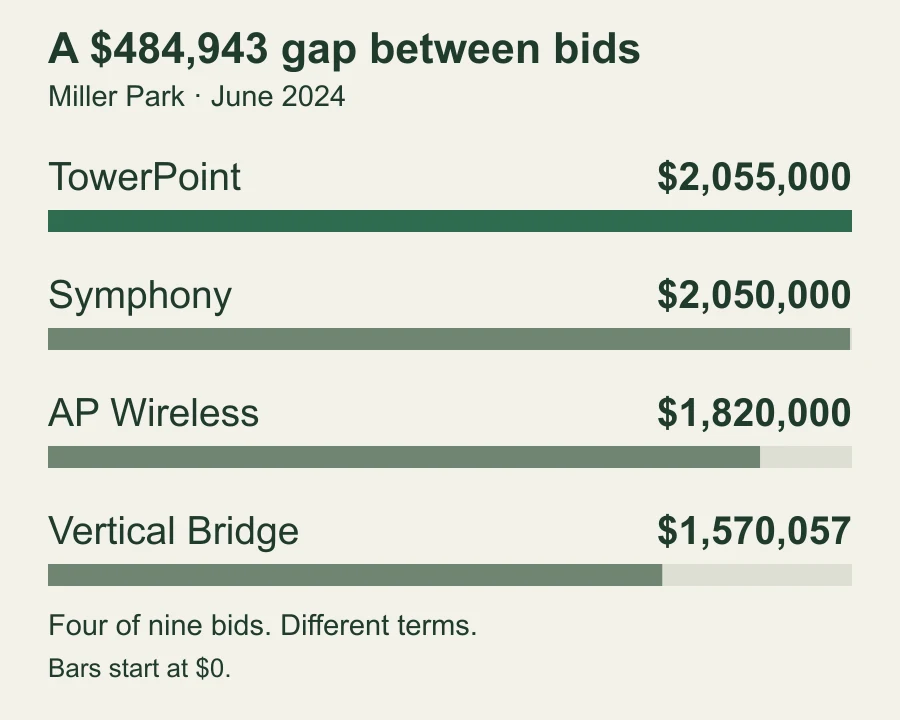
The top offer was for a 99-year term. That buyer also wanted the right to take 1,000 more square feet later, with a 50% split of rent from new tenants there. Other bidders wanted rights forever. Price was only part of the picture.
By August, the proposed deal had changed to $2,001,000 and a permanent easement. The terms moved after the bidding.
Get several bids before you pick a buyer. Ask about future income, not just today's check. Then make sure the final contract still matches the deal you agreed to.
When the final offers are close
In Panama City, Florida, the final offers for a tower easement in January 2025 were $735,000 from Crown Castle, a tower company, and $742,000 from TowerPoint, a lease buyer. The $7,000 gap was less than 1% of the lower offer.
A second offer won't always be much higher. When prices are this close, compare what you keep after costs. Then compare the rights each buyer wants and when each can cut the price or walk away.
Four bidders, a $199,500 spread
In Jamesburg, New Jersey, four buyers bid on the same tower lease on August 16, 2012. Offers ranged from $464,500 to $664,000, a $199,500 difference.
| Bidder | Offer |
|---|---|
| Wireless Capital Partners, LLC | $664,000 |
| Landmark Dividend | $609,000 |
| Telecom Lease Advisors | $570,000 |
| Communications Capital Group | $464,500 |
Even the top two bids were $55,000 apart. One buyer's price is not the ceiling. Give every serious buyer the same lease papers and a deadline for written offers. Then compare the money and terms side by side.
How do you compare two offers?
Look at what each buyer wants, not just the price. Buying a few years of rent is not the same as taking a permanent easement or the right to add tenants.
| What to compare | What to ask each buyer |
|---|---|
| Payment | One lump sum, payments over time, money tied to conditions, or a mix? |
| Costs taken out | Which fees, costs, held-back money or loan payoffs come out at closing? |
| Rent sold | Only today's rent, or also renewals, increases and new tenant rent? |
| How long | Current lease only, a set period, renewals, or no end date? |
| Land involved | Exact footprint, access road, utility path and room to expand? |
| Buyer rights | Access, utilities, equipment, expansion, moving the site, renting space to others or adding tenants? |
| Your duties | Notices, access, upkeep, taxes, insurance or cooperation? |
| Exclusivity | Can you talk to other buyers? If not, for how long? |
| Buyer conditions | Title, survey, lender, approvals, who can sign, or the buyer's own review? |
| Buyer's way out | When can the buyer walk away, and who pays the costs? |
| Future land plans | Selling, refinancing, splitting, building, passing to heirs or moving into a company? |
What are you actually selling?
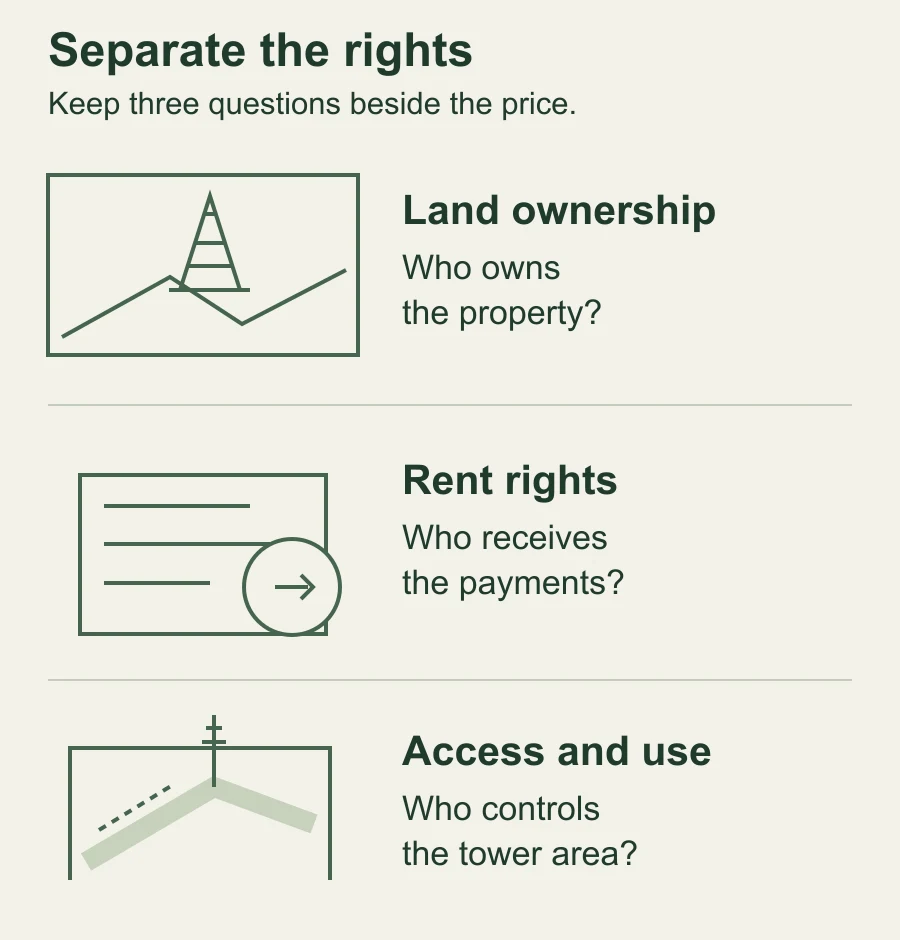
A buyout can sell your rent, your lease rights, rights to your land or a mix. Giving someone the right to use part of your land is an easement. Know which one you are signing.
| Deal type | What you sell | Questions to settle |
|---|---|---|
| Rent assignment | Your right to the rent under your current lease | Which rent, start and end dates, and who gets future increases or new rent |
| Lease assignment | Your rights and duties under the lease | Which rights the buyer gets, which duties it takes on and which stay with you |
| Easement for a set time | Use of a set area for a set period | Area, access, utilities, equipment, expansion, moving, cleanup and end date |
| Permanent easement | Rights with no end date, filed with the county | All of the above, plus future sales, loans, building, heirs and splitting the land |
| Land sale | Ownership of the land itself | Boundaries, access, taxes, title and effect on the rest of your land |
| Combination | Two or more of the above | How the papers work together and what lasts after the current lease ends |
Our easement guide explains the land rights. The lease agreement guide shows where to find the matching clauses in your lease.
What is a cell tower lease buyout?
A buyout trades some or all of your tower rent for one payment now. Many deals also give the buyer rights to access, utilities, equipment or part of your land.
How a buyout works, step by step
Most buyouts follow six steps. At each one, know what comes next and who handles it.
1. The first offer
Write down who the buyer is, how they will pay and when the offer expires. Note what kind of deal it is and any terms called binding. Ask for the full set of proposed contracts.
2. Gather your lease and ownership papers
Pull together the lease, every amendment, payment records, the deed, mortgage details and proof of who can sign. No copy of the lease? Check your own or your family's files. You can also ask the tower company in writing for a copy of the lease and every amendment. Make sure the owner and the person who gets the rent are named correctly.
3. Compare the offers
Line up every offer side by side, using the comparison table above. Price, rights, costs and the buyer's way out all count.
4. Buyer checks and conditions
Track the title check, the survey, the lender, approvals, who can sign, the estoppel and recording. The buyer can rely on it later. Note who handles each open item and when it is due.
5. Review the final contract
Compare the closing papers with the first offer and the letter of intent. List every change to payment, rights, costs, conditions and ongoing duties.
6. Signing, recording and payment
Confirm which papers you will sign and which get recorded. Find out when the money is released, what comes out on the closing statement and which duties continue after.
What papers should you gather?
Put these in one folder before you compare offers:
- The original lease and every amendment.
- Your latest rent statement and payment history.
- Notices about tenant changes, transfers or rent changes.
- Any memorandum of lease, easements or transfers filed with the county.
- Your deed, the legal description and any survey.
- Mortgage and lender details.
- Property tax and insurance details for the leased area.
- The first offer, letter of intent and every draft contract.
- Trust, estate, company, association or government papers showing who can sign.
- Anything in writing about payment, timing, costs, rights or duties after closing.
A missing amendment can throw off your numbers. The rent, leased area, tenant or renewal options may have changed since the lease was signed.
The four papers people mix up
The first letter is rarely the whole deal. Know what each paper does.
| Paper | What it usually covers | What it does not settle on its own |
|---|---|---|
| Offer letter | Proposed price and main terms | The full deal, every condition or the final contract |
| Letter of intent | Early deal terms and any binding parts | That the final papers won't add terms |
| Purchase agreement | Duties, conditions, costs, what happens if a side backs out, and closing steps | Your full land rights, unless read with the related papers |
| Assignment or easement | The rent, lease, access or land rights sold | Every duty tied to the deal |
Read all the papers together. A good offer summary does not fix a broader easement, an open buyer condition or a cost hidden in the closing papers.
Who is making the offer?
Find out who you are dealing with before you judge the number. The company on the envelope, the salesperson's employer, the buyer and the company that signs the final contract may all be different.
Write down:
- The full legal name of the company making the offer.
- Whether it is your tenant, the tower company, a lease buyer, a broker, an adviser or another middleman.
- The company that will sign the purchase agreement.
- Whether it can hand the deal off to another company.
- The address, website, phone number and state business registration you used to check them.
- Any fees, referral pay or other ties they told you about.
Our buyer and adviser guide explains who does what. Confirm who will own the rights after closing.
Which lease clauses matter?
Find these clauses in your current lease before you accept an offer. Use the original lease plus every amendment, not just a summary:
- Assignment and whether you must agree.
- Right of first refusal, or right of first offer.
- How notices must be sent, and to what address.
- How long the lease runs and its renewal options. The date the lease was signed, the date rent started and the date the term started can all differ, and amendments can move them. Go by the newest signed version.
- Rent increases and payment timing.
- Rights to end the lease early.
- Access, utilities, equipment, expansion and moving the site.
- Extra carriers on the tower, rent sharing and subleasing.
- Mortgage lender clauses, often called subordination and non-disturbance. They decide whether the tower lease survives if your lender forecloses.
- Damage, the government taking the land, equipment removal and site cleanup.
Don't rely on a summary. Read every amendment with the original lease. A real estate lawyer can tell you what a clause means before you close.
Red flags in a buyout offer
Slow down if you see any of these:
- A big price but no full contract to read.
- A deal summary that doesn't match the assignment or easement.
- Unclear length, area, future income, access, expansion or relocation rights.
- Spoken promises that are not in writing.
- Exclusivity (you can't talk to other buyers) or secrecy terms nobody pointed out before you signed.
- The buyer can walk away easily, but you stay locked in.
- Fees, held-back money or recording costs not shown in the price.
- Blank exhibits, missing land descriptions or papers mentioned but not provided.
- Pressure to sign before title, lender, legal or tax questions are answered.
Get the missing paper or a written answer before you go further.
What happens to your land after closing?
Papers filed with the county stay with the land. They can matter when you sell, refinance, split, build on, pass down or move the land into a company. Don't accept a promise that “nothing changes” without checking.
Ask:
- What will be filed in the county land records?
- What area and access roads does it cover?
- Can the buyer expand, move, sublease or add equipment?
- Which of my duties pass to future owners?
- Do I need to give notice or get approval to sell or borrow?
- Who gets rent from renewals, new equipment or new tenants?
- What happens when the current lease ends?
What about taxes?
Figure out the tax bill before you plan how to spend the money. Timing, your cost basis and the rights you sell all change what you keep. Cost basis is roughly what you paid for the property. For inherited land, it is usually the value when you inherited it.
Show your tax adviser the proposed contract before you sign. Want a like-kind exchange (putting the money into other property to put off the tax) or payments over time? Bring it up early so it can be built into the deal.
Should you take the offer?
Use the price ranges above as your guide. A 22x offer is a strong start, not a reason to stop reading the contract.
Ask yourself:
- Do I know who the buyer really is?
- Do I have every proposed contract and exhibit?
- Do I know exactly which rent and land rights I am selling?
- Do I know how long each right lasts?
- Did I compare the cash I keep, not just the price?
- Did I count rent increases and renewal options?
- Do I know how this affects my future plans for the land?
- Have my lawyer, lender, title company and tax adviser answered their questions?
- Does the lump sum fit my goals better than keeping the rent?
Our sell-or-keep guide helps you weigh the cash against keeping the rent.
What if you don't sign?
If you don't sign a buyout contract, the buyout doesn't happen. Your current lease stays in force, unless you already signed another binding paper.
You can ask for missing papers, ask for changes in writing, get another offer or walk away. If you already signed a letter of intent or exclusivity agreement, check it before you talk to another buyer.
Frequently asked questions
Do I keep the land after a buyout?
If you sell only the rent or grant an easement, you keep the land. If you sell the land itself, you don't. Read the legal description and recorded papers to see what stays yours.
Is an assignment the same as an easement?
No. An assignment sells the rent or lease rights. An easement gives the right to use part of your land. One deal can include both.
Is the offer letter the final contract?
Usually not. The offer letter lists proposed terms. The final contracts set the real deal. Check whether any part of the offer or letter of intent is binding.
What is a buyout multiple?
Divide the offer by your yearly base rent. If you get $2,000 a month, a $480,000 offer is 20x yearly rent. Use the multiple to compare offers, then check the rights and costs.
How long does a buyout take?
There is no set timeline. It depends on gathering papers, title, survey, lender, approvals, the buyer's checks, negotiation, recording and payment.
Can a buyout affect a later property sale or refinance?
Yes. Recorded rights, ongoing duties, lender rules and who gets future rent can all matter later.
Compare your offer
Enter your rent, increases, offer and costs in the calculator. Then use the checklist above to compare the rights and terms.